- Humans + AI with Ross Dawson
- Posts
- Why AI won't take your job, don't treat AI agents like employees, reimagining higher education, and more
Why AI won't take your job, don't treat AI agents like employees, reimagining higher education, and more

Strategy is and will remain the province of humans. However AI can massively amplify the quality, velocity, and robustness of strategy.
After extensive development our AI-augmented strategy platform Fraxios is entering Beta, with a handful of global organizations already involved. There are a handful of places left on the program, which is limited so we can create maximum value for participants.
Please apply for the beta program if interested.
Have a great week! Ross
💡Signal of the week
I have long been prioritizing 'Humans + AI Teaming' as the critical next phase after individual augmentation.
It seems that now others are reaching the same conclusion, with three articles in Harvard Business Review in the last two months on AI and teams, and a wealth of new research papers on the topic.
🖼️Framework: Workflow Principles
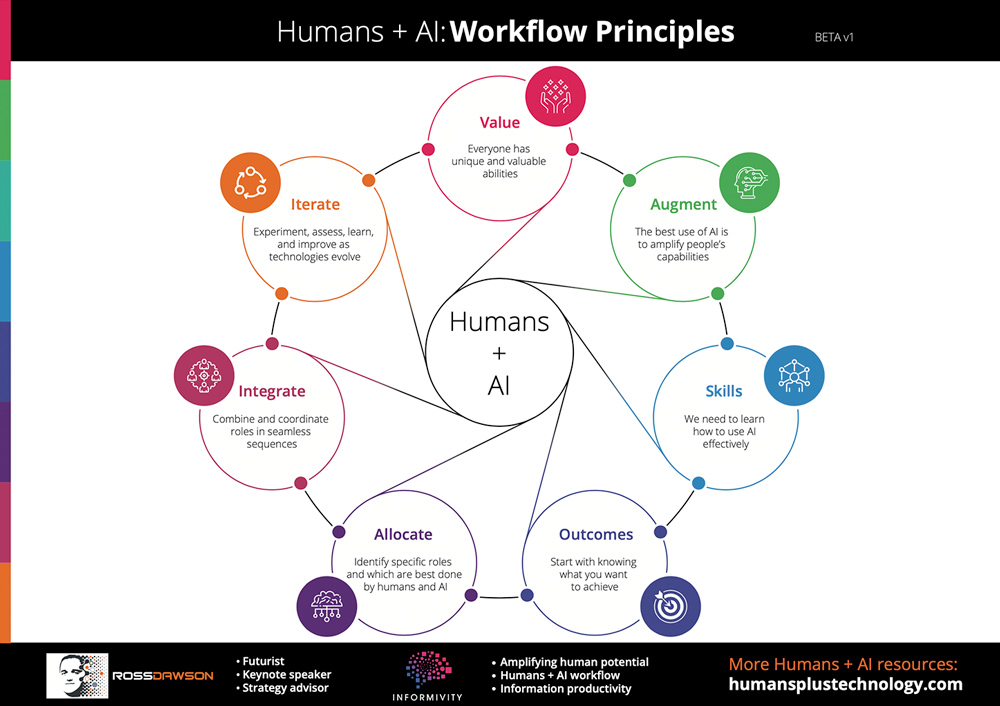
Designing effective human-AI workflows is harder than it looks. Without clear guiding principles, teams often default to automating everything or resisting change entirely — missing the real opportunity in between.
Workflow Principles gives you seven practical lenses for thinking through how humans and AI should divide, share, and hand off work. Use it when redesigning a content review process, for example, to decide which steps genuinely benefit from AI speed and which ones still need human judgment front and center.
⚡This week’s signals
Box CEO Aaron Levie argues that AI tools can handle roughly the first 80% of most tasks, but people mistake that visible capability for the whole job — when in fact the remaining 20%, where real expertise and judgment live, is where most of the value sits. He also predicts that AI agents will multiply rather than replace software use, and that tomorrow's engineers will be embedded across industries like pharma, not concentrated in tech firms.
The human-AI division of labor isn't a simple percentage split — it's the last mile where domain expertise meets accountability that holds the most value, and that mile remains stubbornly human.
A large-scale BCG experiment found that framing AI agents as 'employees' on the org chart quietly eroded human accountability, increased unnecessary escalation, and degraded the quality of review — without improving how readily people adopted the technology. The researchers argue the real design challenge is not whether to deploy agentic AI but how to restructure workflows and governance so humans remain clearly responsible for outcomes.
The workplace metaphor we assign to AI agents is not cosmetic — it actively shapes how much human accountability survives the transition, making role design one of the most consequential decisions leaders will face.
Andrew Ng pushes back hard on mass-unemployment predictions, pointing to robust software hiring, a 4.3% US unemployment rate, and a telling structural incentive: AI labs and SaaS companies profit from anchoring their pricing to salaries, giving them every reason to amplify displacement fears. He foresees an 'AI jobapalooza' instead, with new engineering roles multiplying well beyond the traditional tech sector.
The loudest labor-replacement narratives often reveal more about who benefits from telling them than about what AI is actually doing to employment — following the incentives is as important as following the data.
📊AI in Enterprise Report
Stanford HAI and Google DeepMind launch AI and Organizations Lab; announce winners of the AI for Organizations Grand Challenge
A $100,000 research challenge drawing 200+ proposals from 156 universities signals that rigorous science on AI-human coordination is finally arriving at scale.
• The winning research will build a 'large coordination model' trained on the grammar of effective team interaction — treating coordination itself as learnable structure.
• DeepMind will deploy the winning model inside its own offices, making a major AI lab a live test bed for AI-augmented teamwork.
• Stanford's new AI and Organizations Lab formalises a dedicated research infrastructure for how AI reshapes collective intelligence and organisational behaviour.
Organisations should watch this lab closely — the coordination models emerging from this work could redefine how human-AI teams are designed, measured, and managed within three to five years.
🔬Latest Humans + AI Research
Human-AI Productivity Paradoxes: Modeling the Interplay of Skill, Effort, and AI Assistance
This model explains why giving people more AI assistance can paradoxically reduce team output—and who gets hurt most.
• When workers can lean on AI, lower-skilled people reduce their effort enough to erase the productivity gains the AI was supposed to deliver.
• AI unreliability compounds this: workers who can't judge when the AI is wrong get worse outcomes than if they'd worked without it.
• Differences in AI literacy cause skill polarisation over time—capable users pull ahead while others fall further behind, splitting your workforce.
What specific interventions—task design, feedback loops, or training—can break the paradox without simply removing AI access from those who need it most?
🌐From Humans + AI Community
Paul Epping shares a rich narrative and exploration: "The Meta Technological Sprint and the Meta-Crisis".
He asks: What happens when exponential capability enters a civilization struggling with coordination failure, epistemic fragmentation, short-term incentives, and institutional lag?
🎧Humans + AI Podcast
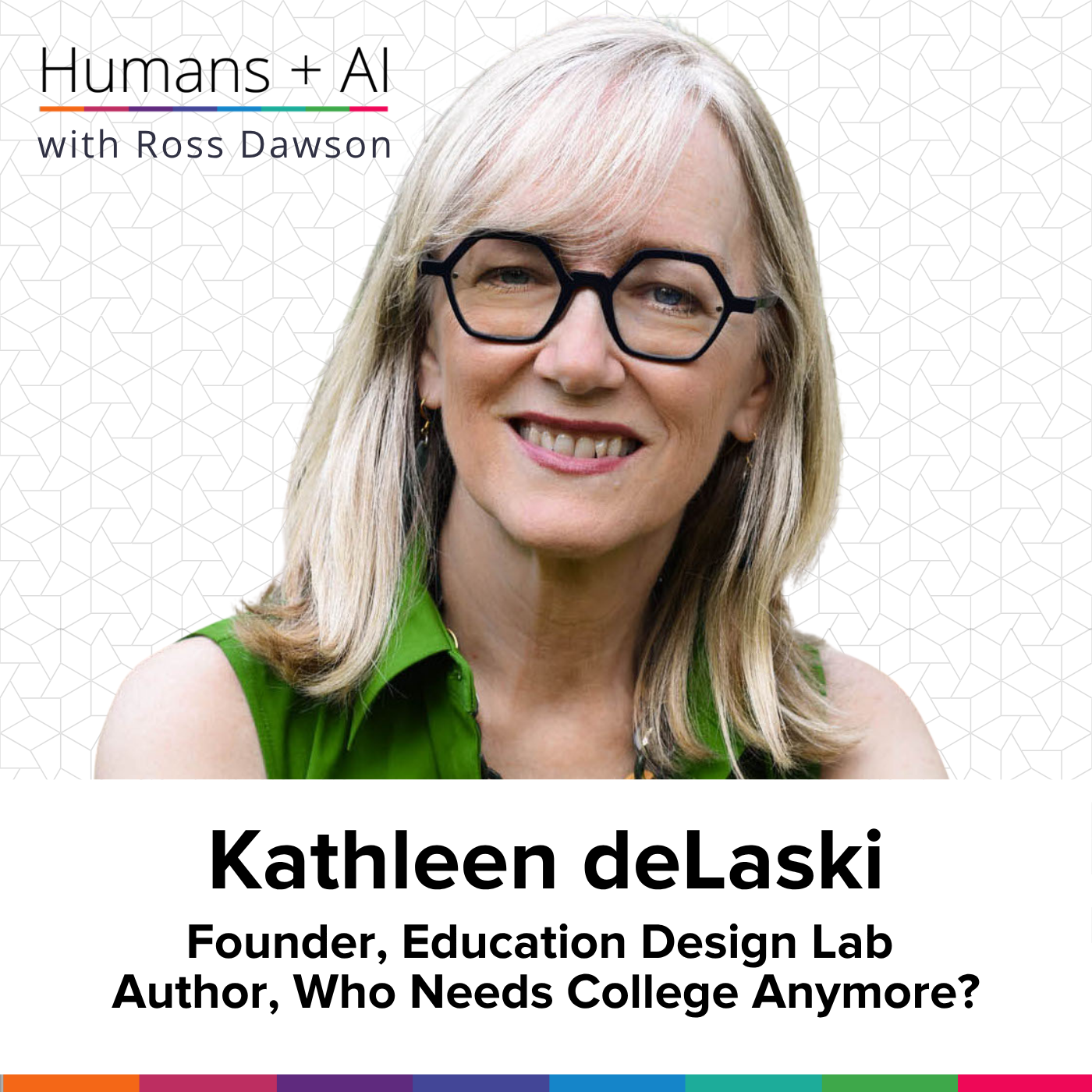
Kathleen deLaski on reimagining higher education, generational mobility, building AI skills, and human originality (AC Ep43)
Listen nowWhy you should listen
What if the college degree is no longer the best path to a better life — and AI is forcing us to finally reckon with that?
This episode digs into how higher education is being stress-tested by automation, why generational mobility demands a broader rethinking of what "skills" even means, and where genuine human originality fits in a world where AI can produce competent work on demand.
After listening, you'll question assumptions about credentials, learning, and what it truly means to add value that machines can't replicate.
Join the Humans + AI Explorers community
The Humans + AI Explorers community brings together forward-thinking professionals exploring what it means to work, think, and lead alongside AI. Weekly events, curated discussions, and direct access to the people shaping this transition. Free membership available — premium tier for deeper access.
Thanks for reading!
Ross Dawson and team