- Humans + AI with Ross Dawson
- Posts
- Frontier models, AI Capabilities Spiral, cognitive prostheses, aligning agent work, and more
Frontier models, AI Capabilities Spiral, cognitive prostheses, aligning agent work, and more

I'm excited for the launch of the Humans + AI Leaders Lunch series with 'Building Humans + AI Organisations' in Sydney on Tuesday.
We have a fantastic panel lined up, but I'm particularly keen on the experience of the roundtable discussions after, which will be a beta for my new event collective intelligence tool, which records live conversations and distills insights within and across the groups. I'll report back.
I'm also diving a lot more into emerging Humans + AI organizational structures, I'll be sharing some structured content on that soon.
Have a great week! Ross
💡Signal of the week
The frontier models are taking us into new Humans + AI territory, I know I'm not the only person who has been spending massive chunks of time engaged with Fable 5 in doing more than I have ever been able to do before.
AI amplification is now less about just using LLMs well, it's about getting the most out of the extraordinary capabilities at the edge. The whole landscape is moving incredibly fast, with GPT 5.6 out a week ago and Kimi K3 out on Friday at a comparable performance level to Fable at significantly lower prices.
🖼️Framework: AI Capabilities Spiral
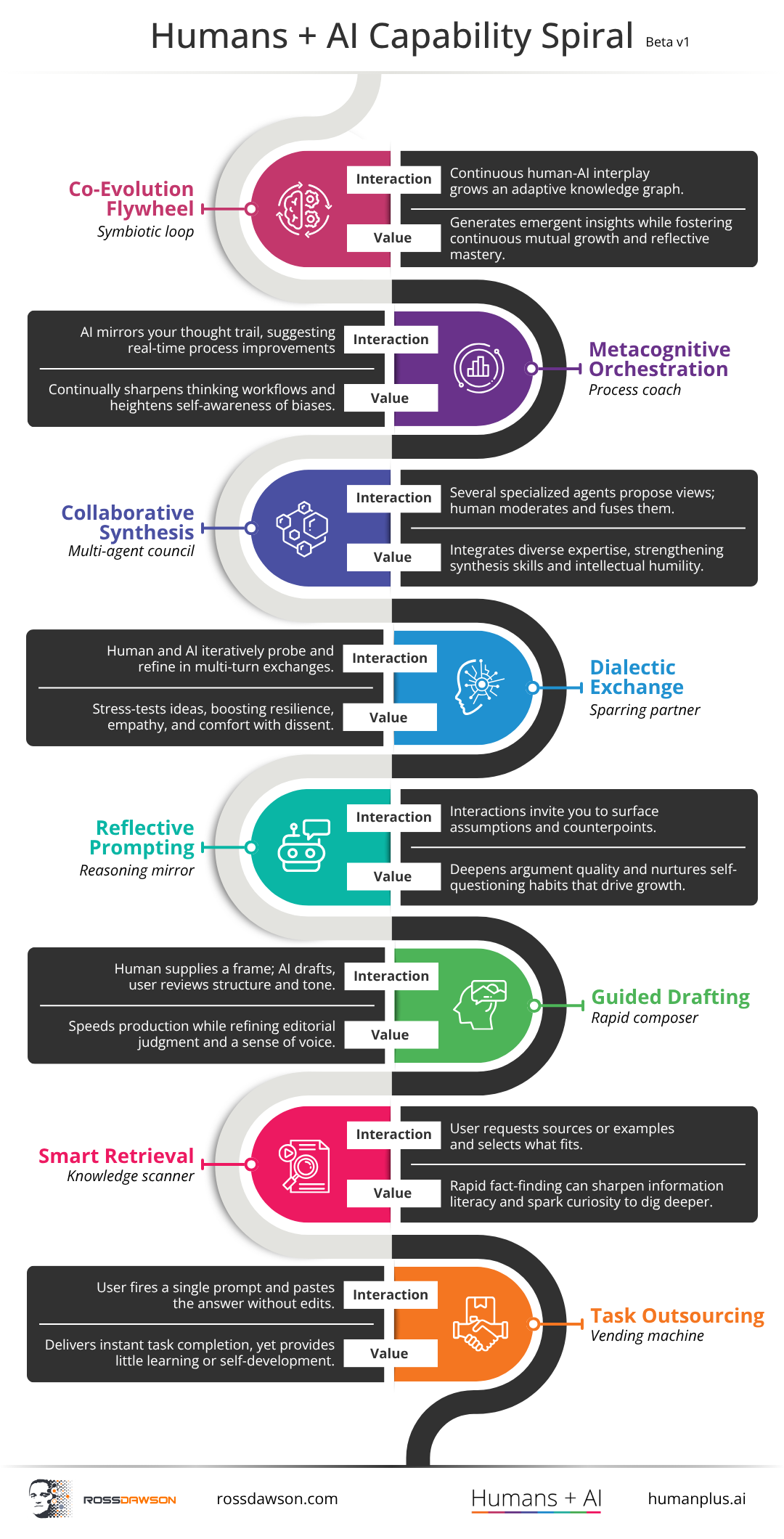
The AI Capabilities Spiral arranges eight common modes of human-AI interaction from the least to the most developmental. At the base, task outsourcing and smart retrieval deliver results with little learning; in the middle, guided drafting, reflective prompting, and dialectic exchange keep the person actively thinking; at the top, collaborative synthesis, metacognitive orchestration, and the co-evolution flywheel compound human capability over time. Each mode is named with a working metaphor and described by how the interaction runs and the value it creates.
⚡This week’s signals
A Brown University professor who suspected heavy AI use moved his final exam to a handwritten, in-person format, and scores dropped by roughly half compared with AI-era coursework marks. It is a concrete measure of how much apparent performance belonged to the model rather than the student.
Take AI out of the room and watch measured capability fall: assessment is where the deskilling question finally gets an answer.
Brookings researcher Niam Yaraghi argues that AI's productivity gains are underwritten by the judgment of workers trained before AI arrived, and that by hollowing out the junior roles through which that judgment is built, the boom consumes its own preconditions. The piece connects the entry-level displacement, deskilling, and expertise-pipeline debates into a single, urgent argument.
Today's AI gains draw down a stock of human expertise nobody is replenishing, making this the central human-capability design problem of the decade.
Therapist and organizational thinker Esther Perel warns executives that asking a chatbot instead of a colleague removes not just one interaction but all the conversations that would have followed, slowly eroding the connective tissue organizations depend on. She frames AI mediation at work as a relational cost that balance sheets do not yet know how to measure.
The hidden cost of frictionless AI help is the slow erosion of the human relationships that make genuine collaboration, and organizations themselves, possible.
📊AI in Enterprise Report
JobBench: Aligning Agent Work with Human Will
As enterprises rush to deploy AI agents, a new benchmark built on 1,500 professionals rating their own work reveals a sharp gap between what AI can do and what workers actually want delegated.
• AI agents perform unevenly across 35 professions, with capability scores diverging significantly depending on task type rather than industry or economic value.
• Workers prioritize delegating repetitive, low-judgment tasks to AI, but current agents struggle most precisely where humans most want relief.
• Economic value metrics like GDP contribution are poor proxies for delegation readiness; worker preference is a more reliable guide to effective deployment.
Organizations designing human-AI teams should anchor task allocation to verified worker preference data, not productivity assumptions, to close the gap between agent capability and practical adoption.
🔬Latest Humans + AI Research
The Human-Machine Knowledge Spiral
This paper reframes the foundational theory of organizational knowledge creation to include AI as an active knowledge contributor, not just a tool, with direct implications for how firms should design human-AI collaboration.
• AI systems carry their own form of tacit knowledge, meaning your team is no longer the only source of hard-to-articulate insight driving innovation.
• The firm's core competency shifts from managing human knowledge flows to orchestrating cycles where human and machine knowledge continuously amplify each other.
• Organizations that treat AI as a passive instrument will structurally underperform those that build processes to externalize, combine, and internalize machine knowledge alongside human expertise.
How do firms practically audit and surface tacit machine knowledge before it can be meaningfully integrated into human-AI innovation cycles?
🌐From Humans + AI Community
Our Campfire meeting hosted by Dan Bashaw featured wonderful sharing sessions including Derek Laney on an AI-native video production workflow with an “operating spine” for client feedback and Peter Kaminski with his “Agents in Polyphony” approach: a multi-agent setup with autonomous agents.
🎧Humans + AI Podcast
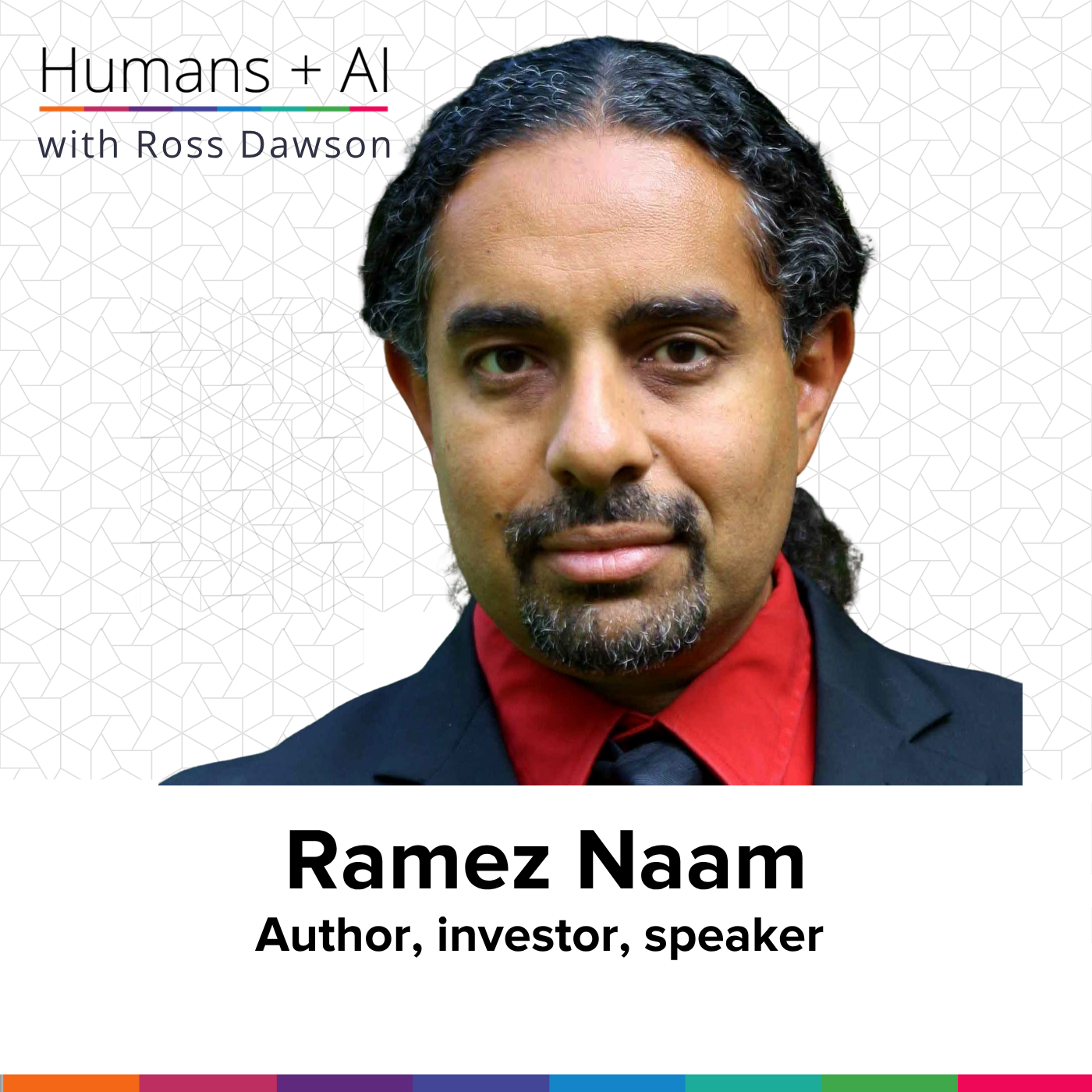
Ramez Naam on cognitive prostheses, the infinite resource, AI and human rights, and mass empowerment of humanity (HAI Ep50)
Listen nowWhy you should listen
What if the most important thing about AI isn't automation but augmentation, turning human minds into something far more capable than evolution ever intended? In this conversation, Ramez Naam explores how AI can function as a cognitive prosthesis, extending memory, reasoning, and creativity for billions of people, and why knowledge itself is the only truly infinite resource.
He tackles the tension between AI's democratizing potential and the real risks of concentrated power, making the case that mass empowerment, not just productivity gains, is the right frame for this moment. You'll finish the episode rethinking what human potential actually looks like when the tools of genius become universally accessible.
Bring the humans + AI conversation to your leadership event
Ross Dawson has delivered keynotes and strategic sessions on the future of organizations, work, and value creation to leadership teams and conferences in over 35 countries. Topics span human-AI collaboration, AI-augmented strategy, future of work, and effective AI leadership. If your team is navigating these questions, please get in touch.
Thanks for reading!
Ross Dawson and team