- Humans + AI with Ross Dawson
- Posts
- Magnificent humanity, benchmarks for human augmentation, accelerating science, and more
Magnificent humanity, benchmarks for human augmentation, accelerating science, and more

I delivered another 'Humans + AI: Infinite Potential' keynote this week, I always love it when clients ask for that, it lets me tell the really big picture!
Many people are positive and open to being inspired by framing the potential in the right way. But some are convinced that job devastation are coming, despite any clear evidence at this point to support that view.
As I said in response to a question on a simlar topic: "I don't know and no-one knows". Nothing is inevitable. It is everyone's role to acknowledge the challenges, see the positive potential, and act to amplify what is possible.
Have a great week! Ross
💡Signal of the week
It is very encouraging to see the rise of benchmarks that are focused on human contribution and Humans + AI capabilities rather than testing AI against what humans can do, as most benchmarks are framed.
JobBench and CentaurEvalare two particularly interesting ones that hava emerged, helping guide AI development towards human augmentation rather than replacement.
🖼️Framework: 3 Elements Driving Human-AI Coevolution
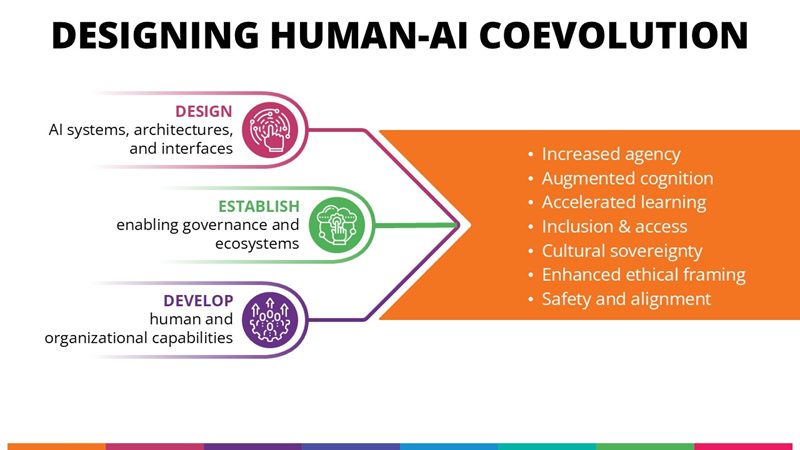
When you're wrestling with how to design AI systems that genuinely serve people rather than just automate tasks, the 3 Elements Driving Human-AI Coevolution gives you a clear lens for making intentional decisions.
It's especially useful when scoping a new AI product or auditing an existing one, for example, asking whether your interface encourages users to think more deeply or quietly erodes their judgment over time.
⚡This week’s signals
Benedict Evans back-tests the popular genre of AI job-exposure charts against accounting, journalism, and taxi medallions — industries whose actual outcomes were the opposite of what task-substitution models would have predicted. His core argument is that jobs reshape under automation rather than disappear, and that the businesses paying for those jobs often transform in ways no task inventory can capture.
Signals that once AI exposure stops being task-substitution arithmetic and becomes a question of how jobs, organisations, and value chains co-evolve, workforce strategy is closer to scenario planning than to headcount math.
Canva's Chief Customer Officer reports on two years of giving all 5,000 employees a full dedicated week to explore AI tools, finding that the binding constraint is behavioural rather than technological — early on, people simply didn't know how to give themselves permission to experiment. Sustained adoption now runs through an AI Hub of self-paced courses, fortnightly forums, internal AI Exemplars, a Show & Tell programme, and a hiring policy that screens for AI fluency at leadership level, where workflow redesign actually happens.
Signals that the gap deciding whether enterprise AI programmes compound over time is behavioural, not technological — and that closing it requires deliberate cultural architecture, not just tool access.
Pope Leo XIV's 42,000-word first encyclical — signed on the 135th anniversary of Leo XIII's landmark labour document Rerum Novarum and presented alongside Anthropic co-founder Christopher Olah — frames AI as the defining social question of our era, warning that delegating decisions on employment, credit, and public services to opaque automated systems risks new forms of exclusion. The document argues that data cannot be left solely in private hands and must be governed as a common good, deliberately centring human dignity, labour, accountability, and the concentration of power rather than capability.
Signals that the most globally influential moral institution has placed AI squarely in the tradition of social justice — shifting the centre of gravity in public discourse from what AI can do to who it serves, who it excludes, and who controls it.
📊AI in Enterprise Report
AI-Ready Data: New rules of data for the advanced AI era
With nearly two-thirds of enterprises running AI in production but almost none properly equipped for it, the data infrastructure gap is now a bottom-line problem.
• Only 7% of companies have built genuinely AI-ready data foundations, despite 64% moving AI beyond pilot stage into production.
• These 'data reinventors' carry an estimated 4.5-percentage-point EBIT-margin advantage and up to 1.6x profit-margin uplift over peers.
• The margin edge comes from treating data readiness as a continuous iterative loop with semantic-layer context, not a one-time transformation project.
Human-AI teams operating on poorly structured data are flying blind — organisations must invest in continuous data readiness or accept that their AI workforce will consistently underperform its potential.
🔬Latest Humans + AI Research
Human-AI Collaboration in Science at Scale: A Global Large-scale Randomized Field Experiment
This is the largest controlled experiment ever run on AI-assisted knowledge work, proving that AI feedback measurably changes expert human behaviour at population scale.
• Receiving AI-generated feedback made researchers 12.5% more likely to revise their work, meaning AI critique drives real action, not just passive reading.
• Exposure to AI feedback durably increased researchers' own LLM use in later papers, suggesting one well-designed AI touchpoint can shift long-term working habits.
• High-quality expert feedback—historically scarce and unevenly distributed—can now be reallocated at global scale without degrading its impact on behaviour.
Does AI feedback improve the actual quality of revised work, or does it mainly increase revision activity without lifting the ceiling on scientific output?
🌐From Humans + AI Community
Paul Epping responds to Peter Diamandis' "AI Will Deliver Wisdom".. "Wisdom resists reduction precisely because it is not one thing. It is a constellation of capacities that different traditions have illuminated from different angles. What is striking, across centuries and cultures, is how consistent they are in what wisdom requires, and how completely artificial prediction systems miss it."
🎧Humans + AI Podcast
Ross Dawson on cognitive friction, beyond Human-in-the-loop, and AI-augmented strategy (AC Ep44)
Listen nowWhy you should listen
What if the goal isn't to remove all friction from AI-assisted thinking, but to deliberately preserve *some* of it? This conversation digs into the idea that cognitive friction can be a feature, not a bug, and why "human-in-the-loop" may already be an outdated frame for how we work alongside AI.
From rethinking what strategic thinking actually requires to exploring where human judgment genuinely adds irreplaceable value, the episode focuses on how we can optimize for depth.
AI-powered strategy intelligence for boards and executive teams — apply for Fraxios beta
Most organizations have a strategy. Almost none have a strategy process that stays current as conditions change. Fraxios is a new platform that structures your strategy as a living architecture across every dimension of your organization, so your leadership team can explore options, surface tensions, and evolve your thinking continuously rather than waiting for the next planning cycle. Now in private beta, working with a small number of organizations on real strategic challenges.
Thanks for reading!
Ross Dawson and team