- Humans + AI with Ross Dawson
- Posts
- AI governance for transformation, cloning your boss, human diversity is required, the case for optimism, and more
AI governance for transformation, cloning your boss, human diversity is required, the case for optimism, and more

This week I gave a keynote to a group of learning leaders of a large global professional services firm. The core message was that there is a massive opportunity for learning to become more central to organizations. In fact it must.
There are a number of obvious - and important - applications of AI to learning, including accelerating content development and personalization of learning content and journeys. What is even more important is the next level, in designing Humans + AI systems so that people are continuously improving their judgment and capabilities.
This week's podcast is a special one, with David Weinberger. If you don't know of him and his work, you should! Check out the episode.
Have a great week! Ross
💡Signal of the week
I have been experimenting with asking my AI system what it finds most exciting and interesting in my work, and what it wants to work on. The results have been eye-opening and very encouraging, it feels like a whole new dimension to the possibilities of AI amplification.
This only works because my systems are built on an extremely rich context structure of all of my work and thinking. What that unlocks is beyond what you might expect.
🖼️Framework: AI Governance for Transformation
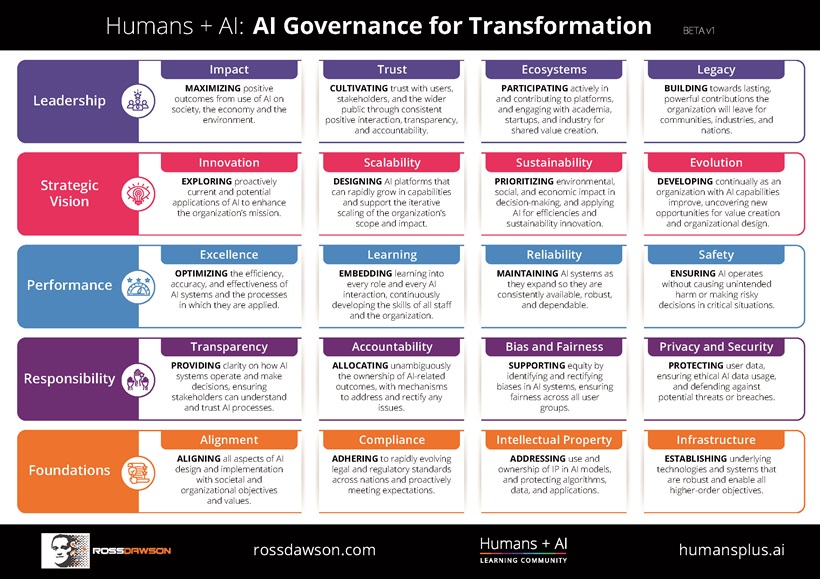
Most organizations racing to adopt AI are doing so without clear rules, roles, or accountability structures. That gap creates real risk, and good governance is what closes it.
AI Governance for Transformation maps the core building blocks your organization needs to deploy AI responsibly and at scale. Use it when standing up a new AI initiative and you need to align leadership on ownership, oversight, and ethical guardrails before rollout begins.
⚡This week’s signals
Platformer reporter Ella Markianos built an AI clone of her editor Casey Newton on six years of his columns, his edit history, and a year of private messages, then ran it as her editor. It caught factual and structural problems competently, but roughly 70% of its comments missed the mark, failing on cultural judgment calls such as whether a post reads as a dunk.
The parts of judgment we cannot articulate are exactly the parts that resist cloning, even when the machine has read everything a person has ever written.
Aaron Horwath argues the malaise in knowledge work predates AI: it comes from workism, the attempt to source a life's meaning from a job. AI accelerates the crisis by stripping out the messy collaborative middle where community and creative satisfaction actually lived, risking the simultaneous defection of a whole professional class.
The deepest disruption from AI may not be lost jobs but lost meaning, as an entire professional class discovers at once that the collaborative middle of the work was the part that mattered.
An Anthropic-commissioned Trajectory Labs study of 1,053 paid developers found human reviewers refused a harmful command inserted mid-session only 13.6% of the time, while the model's own auto-mode guardrails blocked 89%. Simon Willison reports the finding without swallowing it, calling for independent replication.
The human in the loop can be the weakest part of the loop, because approval fatigue erodes exactly the vigilance the design assumes is there.
📊AI in Enterprise Report
The Oversight Fallacy: Why AI Agents Require More than Humans-in-the-Loop
As agentic AI systems move from pilots to production, the gap between nominal oversight and real accountability is becoming a critical enterprise risk.
• A pause or approve button only constitutes genuine oversight when four conditions hold: knowledge of system limits, observation of actions, meaningful control, and timely intervention.
• Most deployed human-in-the-loop mechanisms fail at least one of these conditions, rendering operator oversight largely ceremonial in practice.
• Oversight responsibility belongs to builders and deployers, not individual end users who lack the context or authority to exercise it meaningfully.
Organizations deploying AI agents must audit whether their human review steps meet all four conditions, or redesign workflows so oversight is structurally real rather than a liability checkbox.
🔬Latest Humans + AI Research
Human diversity fuels collective creativity that large language models cannot simulate or sustain
This study reveals a hidden collective cost when teams replace human idea generation with AI: the creative diversity that makes groups outperform individuals quietly disappears.
• AI-generated ideas compress the range of concepts a group produces, specifically erasing the distinctive contributions that non-native English speakers bring to brainstorming.
• Using AI to refine your own ideas rather than generate them preserves group diversity, making that a safer integration point for human-AI creative workflows.
• Even when heavily prompted to simulate diverse human perspectives, AI writer pools consistently fell short of real human variety, meaning digital twins cannot substitute for actual human range.
Can team structures or incentive designs realign individual preference for AI ideation with the collective need to protect creative diversity?
🌐From Humans + AI Community
Sharing and discussion of a framework for AI-complementary skills, going through Think, Assess, Trust, Compound for a reinforcing loop of improving judgment and ability to use AI systems well.
🎧Humans + AI Podcast
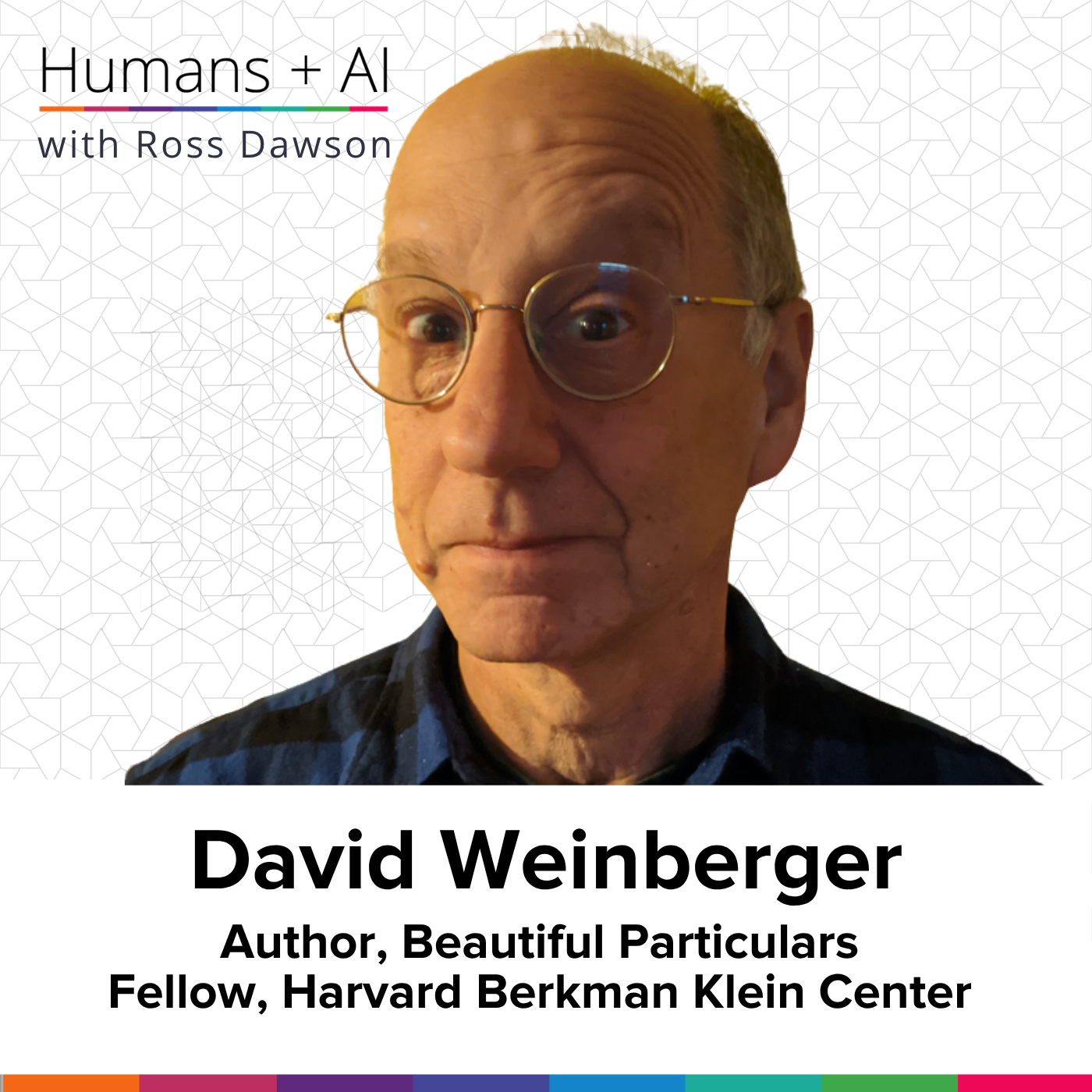
David Weinberger on beautiful particulars, healing the mind/body split, morality, and the case for optimism (HAI Ep53)
Listen nowWhy you should listen
What if the internet's defining feature isn't connection or chaos but the radical preservation of particulars, the irreducible, beautiful specificity of individual things that older systems had to smooth away?
This conversation roams across philosophy of mind, the stubborn legacy of Descartes, how AI forces us to rethink what morality even means, and why genuine optimism is not naive but earned through clear-eyed attention to complexity. You'll finish it reconsidering what it means to truly know something, and feeling unexpectedly hopeful.
Bring the humans + AI conversation to your leadership event
Ross Dawson has delivered keynotes and strategic sessions on the future of organizations, work, and value creation to leadership teams and conferences in over 35 countries. Topics span human-AI collaboration, AI-augmented strategy, future of work, and effective AI leadership. If your team is navigating these questions, please get in touch.
Thanks for reading!
Ross Dawson and team